Dani Pedrosa’s Honda RC212V with Showa Suspension
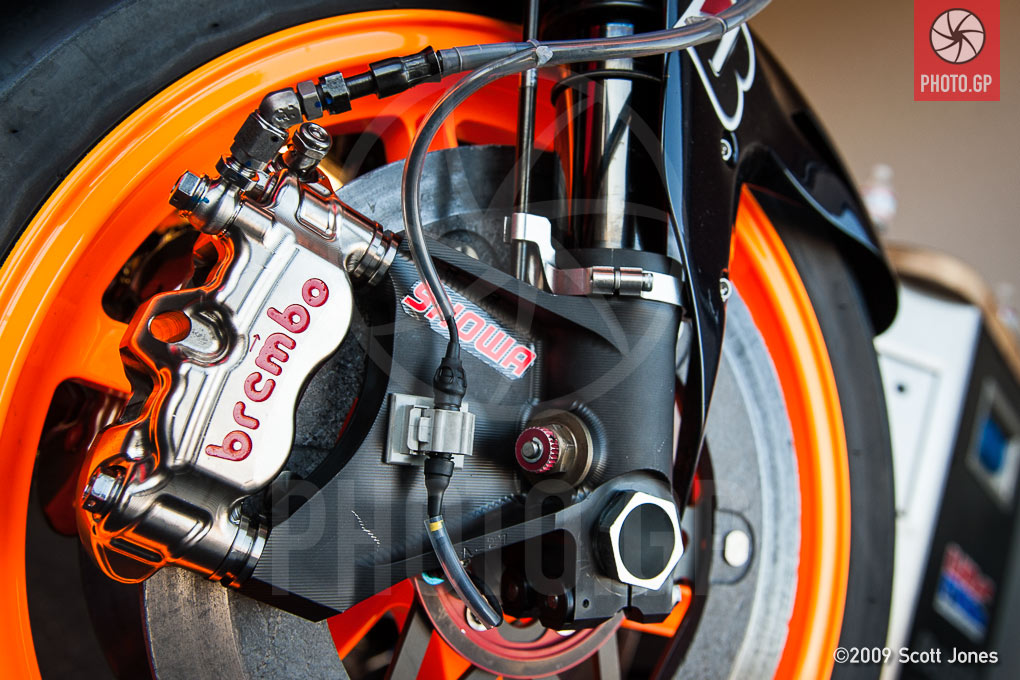
Please click on the above image to view it larger.
MotoGP suspension is such a vital part of a motorcycle’s performance, it’s no surprise that its development is left to specialists rather than built in house by motorcycle manufacturers. For many years Showa was a major player in MotoGP, thanks to close ties to Honda Racing Corporation.
But in 2009, things started to go south for Showa, as various Honda riders defected to Ohlins. Dani Pedrosa stayed with Showa throughout 2009, in spite of teammate Andrea Dovizioso’s decision to switch mid-season. Pedrosa struggled with the new suspension in the winter tests and in 2010 took longer than he wanted to find the feeling with the new Ohlins system.
Showa still appears in MotoGP, but the factory Repsol Hondas still use Ohlins, as do Yamaha and Ducati factory teams, and many other satellite and Open class teams. As of Round 16 at Phillip Island, only Redding, Bautista and Di Meglio are using Showa suspension.
This image from 2009 got me wondering about Showa, and a little researched revealed some interesting facts.
Showa is another Japanese company that contributed technology to the country’s WW II effort, in this case aircraft components. Banned from continuing to manufacture aircraft components after WW II, the company switched to car parts, then branched out to shock absorbers, and so on. Showa now lists as its customers BMW, Ducati, Harley Davidson, Honda, Kawasaki, Mazda, Nissan, Suzuki, Toyota, Triumph, and Yamaha.
Its name comes from the Showa period of Japanese history, corresponding to the reign of the Shōwa Emperor, Hirohito, from December 25, 1926, through January 7, 1989. According to Wikipedia, ‘Shōwa era may also be translated as “period of radiant Japan” or “period of Japanese glory.”‘
Photograph: ©2009 by Scott Jones / PHOTO.GP – All Rights Reserved
[mgallery keyword=”Team Repsol Honda”]





Please sign in or register to contribute a comment or question.